Admin
Admin 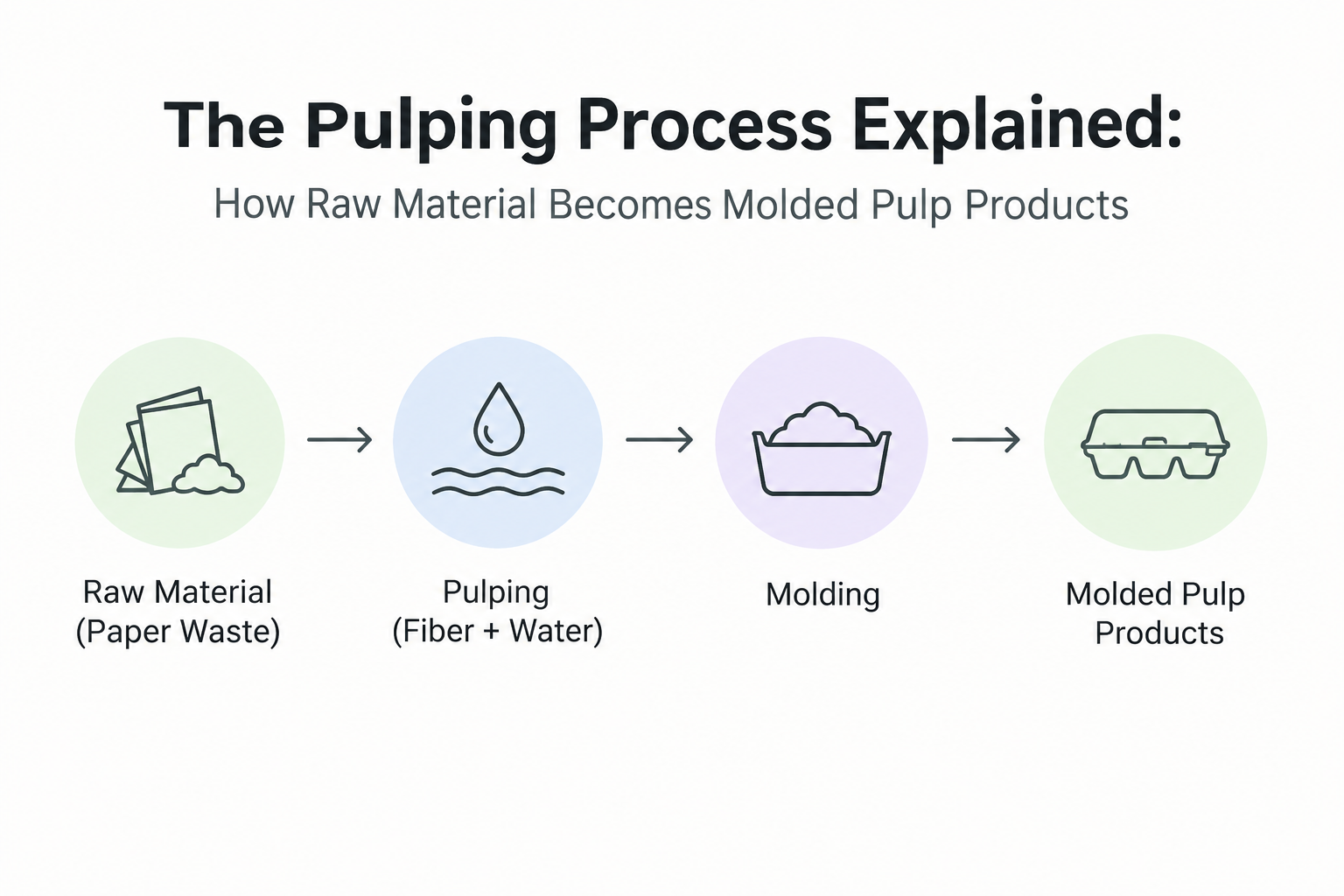
Molded pulp products such as egg trays, fruit trays, cup carriers, protective packaging inserts, disposable tableware, and industrial packaging are becoming increasingly common across different industries. But how are these products actually manufactured?
The answer begins with the paper pulping process.
Paper pulping converts fibrous raw materials such as recycled paper, cardboard, agricultural residues, or virgin fiber into a wet pulp slurry. This slurry can then be processed, molded, dried, and finished into a wide range of molded pulp products.
A modern pulp molding machine works together with a paper pulping machine and other equipment to transform raw materials into finished packaging and tableware products.
In this guide, we explain the complete pulping process, including raw-material preparation, pulping, cleaning, refining, consistency control, molding, drying, and finishing. We also explain the different types of pulp manufacturing equipment, applications, benefits, challenges, and factors to consider when choosing a production system.
What Is Paper Pulping?
Paper pulping is the process of breaking down fibrous raw materials into individual fibers and mixing them with water to create a wet pulp slurry.
Common materials used in the paper pulping process include:
- Recycled paper
- Corrugated cardboard
- Waste office paper
- Newspaper
- Bagasse
- Wheat straw
- Bamboo fiber
- Virgin wood fiber
During pulping, the fibrous material is mechanically broken down so that the individual fibers can be separated and suspended in water.
The resulting pulp becomes the primary raw material for manufacturing paper products and molded pulp packaging.
The quality of the pulp is important because fiber length, consistency, cleanliness, and material composition can influence the strength, appearance, and performance of the final product.
Why Is Pulp Manufacturing Important?
The demand for pulp manufacturing has increased as businesses and industries explore alternatives to conventional plastic packaging.
Molded pulp can be manufactured using recycled fiber and other suitable plant-based raw materials, making it an important material for sustainable packaging applications.
The growth of molded pulp packaging is particularly noticeable in areas such as:
- Food packaging
- Agriculture
- Consumer goods
- Electronics
- Industrial packaging
- Hospitality
- Retail
For manufacturers, modern pulp manufacturing equipment can provide a way to convert suitable waste fiber and other raw materials into commercially useful products.
How Does the Paper Pulping Process Work?
The paper pulping process consists of several stages. Each stage prepares the material for the next part of production.
The general process includes:
- Raw material collection and sorting
- Pulping
- Cleaning and screening
- Fiber refining
- Consistency control
- Pulp molding
- Drying
- Trimming and finishing
- Stacking and packaging
Let’s look at each stage in detail.
Step 1: Raw Material Collection and Sorting
The first stage of the pulping process is selecting and sorting the raw material.
Recycled cardboard, newspaper, waste paper, and other suitable fiber sources can be used depending on the intended product.
Agricultural fibers such as bagasse, wheat straw, and bamboo can also be used in appropriate pulp manufacturing systems.
Before entering the pulping equipment, the raw material needs to be inspected and sorted to remove unwanted contaminants such as:
- Plastic
- Metal
- Staples
- Tape
- Other non-fibrous materials
Effective sorting is important because contaminants can affect pulp quality and potentially cause blockages or wear in downstream equipment.
Step 2: Pulping – Breaking Down the Fiber
Pulping is the core stage of the paper pulping process.
The sorted raw material is mixed with water inside a hydrapulper or paper pulping machine.
The machine uses mechanical agitation to break the material down into individual fibers and create a consistent pulp slurry.
A properly operated paper pulping machine helps prepare the raw material for subsequent cleaning, refining, and molding operations.
The quality of this stage can influence the strength and consistency of the final molded product.
Step 3: Cleaning and Screening
After the initial pulping stage, the pulp slurry passes through cleaning and screening equipment.
The purpose of this stage is to remove remaining unwanted materials such as:
- Plastic fragments
- Sand
- Staples
- Metal particles
- Other contaminants
Screens separate larger unwanted materials from the fiber slurry, while cleaners can help remove heavier particles.
Effective cleaning helps protect the pulp molding machine and other downstream equipment while improving the quality of the pulp.
Step 4: Fiber Refining
Following cleaning, the pulp can undergo refining.
Refining modifies the characteristics of the fibers according to the requirements of the finished product.
Depending on the application, fiber properties can be adjusted to support characteristics such as:
- Strength
- Smoothness
- Formation
- Fiber bonding
The refining stage therefore plays an important role in preparing pulp for different types of molded pulp products.
For example, packaging designed to protect heavy or fragile products may require different fiber characteristics from lightweight disposable tableware.
Step 5: Pulp Consistency Control
Pulp consistency refers to the proportion of fiber relative to water in the slurry.
Maintaining appropriate consistency is an important part of the paper pulping process because variations can affect the formation and thickness of the finished product.
Before the pulp enters the molding stage, the slurry is adjusted to the required consistency for the selected product and production system.
Proper consistency control helps improve:
- Product uniformity
- Wall thickness
- Mold filling
- Fiber distribution
- Production stability
Step 6: Pulp Molding
Once the pulp has been prepared, it moves to the pulp molding machine.
This is where the wet fiber slurry is transformed into a three-dimensional product.
The molding system uses molds and vacuum suction to draw the pulp onto the mold surface. Water is removed from the slurry while the fibers form around the mold.
Depending on the mold design, the same general pulp molding process can be used to manufacture products such as:
- Egg trays
- Fruit trays
- Cup carriers
- Protective packaging inserts
- Plates
- Bowls
- Industrial packaging components
- Nursery trays
The mold design determines the shape and dimensions of the finished product.
Step 7: Drying
After molding, the product contains a significant amount of moisture and needs to be dried.
Drying can be performed using drying tunnels, hot-air systems, hot presses, or other suitable equipment depending on the production configuration.
The purpose of drying is to remove remaining moisture and help the molded product achieve the required shape and structural characteristics.
Drying is an important part of pulp manufacturing because inefficient moisture removal can affect production speed, energy consumption, and product quality.
Step 8: Trimming and Finishing
Once the molded products are sufficiently dry, additional finishing operations may be required.
These can include:
- Edge trimming
- Surface finishing
- Removal of excess material
- Inspection
- Stacking
Trimming improves the final appearance and ensures that the product conforms to the required dimensions.
Depending on the type of molded pulp packaging, additional finishing processes may also be incorporated into the production line.
Step 9: Stacking and Packaging
The final products are then counted, stacked, and prepared for packaging.
Automated systems can help reduce manual handling and improve consistency during this stage.
The finished products can then be packed and prepared for storage, transportation, or distribution.
For high-volume pulp manufacturing, automated stacking and packaging can help streamline the overall production process.
What Is a Pulp Molding Machine?
A pulp molding machine is equipment designed to convert prepared pulp slurry into three-dimensional molded products.
During the molding process, vacuum suction draws the pulp onto a mold surface. Excess water is removed, leaving a wet fiber structure that can then be dried and finished.
Modern pulp molding machines can be configured for different production requirements and product types.
Common machine configurations include:
Rotary Pulp Molding Machines
Rotary systems continuously move molds through different stages of the production cycle and can be suitable for higher-volume manufacturing.
Reciprocating Pulp Molding Machines
Reciprocating systems move molds between production positions and can be configured for different product requirements.
Thermoforming Pulp Molding Machines
Thermoforming systems use heat and pressure to provide more precise shapes and surface characteristics for selected molded-fiber applications.
The appropriate pulp molding machine depends on the product, required output, automation level, available space, and production objectives.
Paper Pulping Machine: The Foundation of Pulp Production
A paper pulping machine is responsible for converting raw fiber materials into usable pulp slurry.
Often based around hydrapulper technology, the machine breaks down recycled paper, cardboard, and other suitable materials through mechanical agitation.
The quality of the paper pulping machine matters because poorly prepared pulp can create problems during subsequent stages.
A reliable paper pulping machine can help manufacturers achieve:
- Consistent fiber preparation
- Better contaminant removal
- Stable pulp quality
- Improved downstream processing
- Reduced equipment problems
The paper pulping machine and pulp molding machine therefore perform two different but interconnected functions within a molded pulp production line.
Paper Moulding Machine vs Paper Pulping Machine
These two terms are sometimes confused, but they refer to different stages of production.
| Feature | Paper Pulping Machine | Paper Moulding Machine |
|---|---|---|
| Main function | Produces pulp slurry | Shapes pulp into products |
| Input | Paper, cardboard, fiber | Prepared pulp slurry |
| Main process | Fiber breakdown | Molding and forming |
| Output | Wet pulp slurry | Molded fiber product |
| Typical equipment | Hydrapulper | Pulp molding machine |
| Production stage | Preparation | Product formation |
In simple terms, the paper pulping machine prepares the fiber, while the paper moulding machine shapes that fiber into the required product.
Together, they form an important part of a complete pulp manufacturing system.
Complete Paper Pulp Molding Machine System
A modern paper pulp molding machine system can integrate several stages of production into one coordinated manufacturing setup.
A typical system may include:
- Raw material preparation
- Pulping
- Cleaning
- Refining
- Consistency control
- Molding
- Drying
- Trimming
- Stacking
- Packaging
An integrated paper pulp molding machine system can reduce manual handling and improve coordination between different stages.
For businesses producing molded pulp packaging at commercial scale, the level of automation should be selected according to production volume, product complexity, labour availability, and investment requirements.
Common Challenges in the Pulping Process
Although the paper pulping process is well established, manufacturers need to manage several operational challenges.
Raw Material Quality
Recycled materials can vary in fiber quality and contamination levels.
Inconsistent raw material can affect pulp consistency and final product quality.
Water Consumption
The pulping process uses water to create the fiber slurry.
Large-scale facilities therefore need appropriate water-management, filtration, and recirculation systems.
Energy Consumption
Drying can be one of the more energy-intensive stages of pulp manufacturing.
Efficient drying systems can therefore have a significant impact on operating costs.
Equipment Maintenance
Fiber accumulation, screen wear, clogging, and other mechanical issues can affect production if equipment is not maintained properly.
Regular maintenance of the paper pulping machine and pulp molding machine can help reduce unexpected downtime.
Environmental Benefits of Pulp Manufacturing
One of the key reasons for the growth of pulp manufacturing is the increasing demand for alternatives to conventional plastic packaging.
Depending on the raw material and final product, molded pulp production can make use of recycled paper, cardboard, and selected agricultural fibers.
This creates an opportunity to convert suitable waste materials into useful packaging products.
However, environmental performance depends on the complete product lifecycle, including:
- Raw material sourcing
- Energy consumption
- Water management
- Coating materials
- Manufacturing methods
- Transportation
- Disposal infrastructure
Therefore, manufacturers should evaluate the complete production system rather than assuming that every pulp product has identical environmental characteristics.
Applications of Molded Pulp Products
The versatility of the pulp molding process allows manufacturers to produce products for multiple industries.
Egg Trays and Fruit Trays
Molded pulp trays can be used for agricultural and retail packaging applications.
Protective Packaging
Custom-molded pulp inserts can protect electronics, consumer goods, machinery components, and other fragile products during transportation.
Foodservice Products
The pulp molding machine can be configured for selected disposable products such as plates, bowls, and cup carriers.
Industrial Packaging
Heavy-duty molded pulp components can be designed as protective inserts for machinery, parts, and industrial products.
Agriculture
Molded pulp can also be used for nursery pots and seedling trays.
The exact pulp manufacturing process can be adapted according to the required product thickness, shape, strength, and application.
Benefits of Investing in Modern Pulp Manufacturing Equipment
Businesses investing in modern pulp manufacturing equipment can benefit from several operational advantages.
Sustainability
Suitable recycled and plant-based fiber sources can be used to manufacture molded products.
Production Efficiency
Automated equipment can reduce repetitive manual operations.
Product Customization
Different molds can be used to produce different shapes and dimensions.
Consistent Quality
Controlled production parameters can help maintain more consistent product characteristics.
Reduced Manual Handling
Automation across pulping, molding, stacking, and packaging can reduce labour-intensive processes.
Scalable Production
Manufacturers can select equipment according to their current requirements and future production plans.
How to Choose the Right Pulping Process for Your Business?
There is no single paper pulping process that is ideal for every business.
The appropriate production setup depends on several factors.
Production Volume
Determine whether the business requires small-batch production or continuous industrial manufacturing.
Raw Material Availability
Consider whether recycled cardboard, waste paper, agricultural fiber, or another suitable raw material is readily available.
Product Type
An egg tray, protective packaging insert, and disposable tableware product can have very different production requirements.
Product Complexity
Simple products may require relatively straightforward molds, while customized packaging can require more complex tooling.
Automation Level
Businesses can consider semi-automatic or fully automatic pulp molding machine systems depending on production requirements.
Drying Requirements
The drying system should be evaluated carefully because it can significantly influence production capacity and energy consumption.
Maintenance and Technical Support
When purchasing a paper pulping machine or pulp molding equipment, consider installation, training, spare parts, maintenance, and technical support.
Future Trends in Pulp Molding Machine Technology
The development of pulp molding machine technology is increasingly focused on automation, efficiency, process monitoring, and material innovation.
Modern production systems are moving toward improved monitoring of parameters such as:
- Pulp consistency
- Temperature
- Moisture
- Drying time
- Production output
- Equipment performance
Automation and predictive maintenance technologies may also help manufacturers identify production issues earlier and reduce unexpected downtime.
At the same time, research into alternative fibers such as agricultural residues and other renewable materials is expanding the potential applications of pulp manufacturing.
These developments could make molded fiber production more flexible and accessible to businesses with different production requirements.
Frequently Asked Questions About Paper Pulping
What is paper pulping?
Paper pulping is the process of breaking down fibrous raw materials such as recycled paper, cardboard, or suitable plant fibers into a wet pulp slurry.
What raw materials are used in the paper pulping process?
Common materials include recycled cardboard, waste paper, newspaper, bagasse, wheat straw, bamboo fiber, and other suitable sources of cellulose fiber.
What does a paper pulping machine do?
A paper pulping machine breaks down raw fibrous materials in water to create a usable pulp slurry for subsequent cleaning, refining, and molding.
What does a pulp molding machine do?
A pulp molding machine converts prepared pulp slurry into three-dimensional products such as egg trays, fruit trays, cup carriers, protective packaging, and selected disposable tableware.
What is the difference between pulping and molding?
Pulping prepares the raw fiber by converting it into slurry, while molding uses that prepared slurry to create the final product shape.
Is pulp manufacturing environmentally friendly?
Pulp manufacturing can use recycled and renewable fiber materials and can produce molded fiber products suitable for various packaging applications. However, environmental performance depends on raw materials, energy use, water management, coatings, manufacturing, and end-of-life conditions.
How long does the paper pulping process take?
The production time varies depending on the equipment, raw material, batch size, product type, molding system, and drying configuration. A complete production cycle can range from several hours to a full production day.
Can one pulp molding machine produce different products?
Depending on the machine design and mold configuration, different molds can allow a production system to manufacture various product shapes and sizes.
How do I choose a pulp molding machine?
Consider production capacity, product type, raw material availability, automation level, mold requirements, drying system, energy consumption, machine construction, maintenance requirements, and technical support.
Conclusion
The paper pulping process is the foundation of molded fiber manufacturing. It transforms recycled paper, cardboard, agricultural fibers, or other suitable raw materials into pulp that can be converted into useful molded products.
From raw-material sorting and pulping to cleaning, refining, consistency control, molding, drying, trimming, stacking, and packaging, every stage contributes to the quality and efficiency of the final product.
A reliable paper pulping machine prepares consistent fiber slurry, while a pulp molding machine transforms that slurry into products such as egg trays, fruit trays, cup carriers, protective packaging, industrial inserts, and selected disposable tableware.
For businesses planning to invest in pulp manufacturing equipment, selecting the right combination of pulping, molding, drying, and finishing systems is essential.
Production volume, raw material availability, product complexity, automation, energy requirements, maintenance, and technical support should all be evaluated before choosing equipment.
As demand for sustainable and molded fiber packaging continues to grow, modern pulp molding machine technology can help manufacturers build efficient, scalable production systems for a wide range of industries.