Admin
Admin 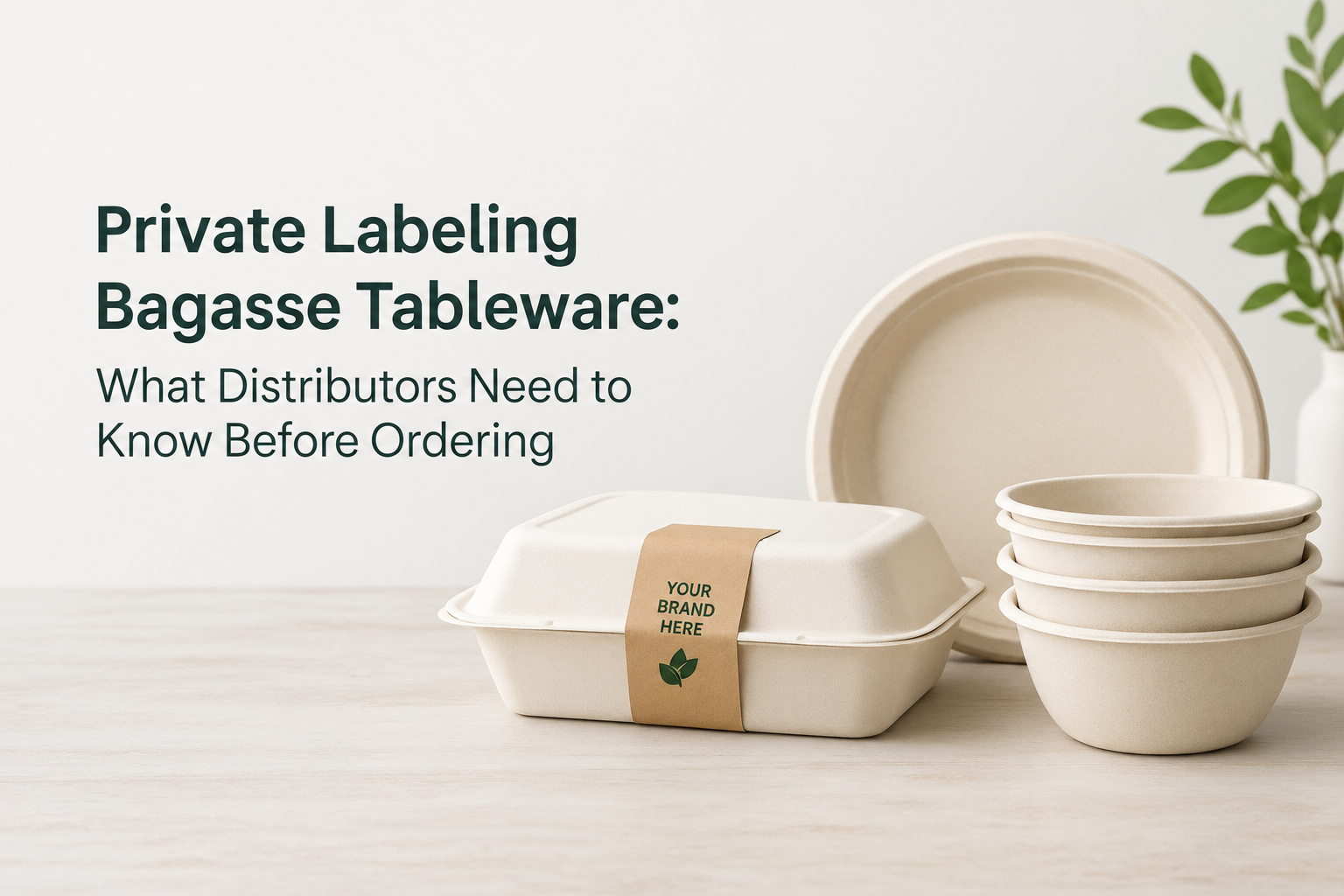
For distributors and foodservice brands looking to build their own identity into sustainable packaging, private label compostable tableware has become one of the fastest-growing categories in the disposables industry. Instead of shipping generic plates and containers with a supplier’s branding – or no branding at all – more distributors are ordering custom branded bagasse packaging that carries their own logo, colors, and messaging straight to the end customer. But it comes with its own set of sourcing questions: minimum order quantities, lead times, tooling costs, and supplier vetting. This guide walks through exactly what to know before you place your first order.
Why Distributors Are Moving Toward Private Label Compostable Tableware
Retailers, restaurant chains, and foodservice distributors are under growing pressure – from both regulation and customer expectation – to offer compostable or biodegradable packaging. Rather than reselling a supplier’s off-the-shelf line, many are choosing private label compostable tableware so the sustainability story is tied to their own brand, not a third party’s. This matters commercially: a distributor selling it under its own name builds brand equity with every order, instead of quietly reselling someone else’s product.
Private label compostable tableware also gives distributors more control over specifications. Instead of accepting whatever thickness, size, or coating a generic supplier offers, a private label buyer can request adjustments to match their target market – heavier-duty plates for grocery deli counters, smaller compartments for airline caterers, or custom shapes for a specific menu.
What Custom Branded Bagasse Packaging Actually Involves
Custom branded bagasse packaging generally falls into two categories: printed branding and molded branding.
- Printed branding applies your logo and design using food-safe ink directly onto the surface of the bagasse product, similar to printing on cardboard packaging. This is faster to set up and works well for smaller minimum orders.
- Molded branding embeds your logo into the mold itself, so the design is pressed into the material during manufacturing. This looks more premium and durable but requires custom tooling, which adds upfront cost and lead time.
When evaluating custom branded bagasse packaging options, ask your supplier which approach fits your order size and budget. Printed branding is usually the right starting point for distributors testing a new line before committing to molded tooling.
Finding the Right Wholesale Eco Tableware Supplier
Choosing a wholesale eco tableware supplier is the single most important decision in this process, since production quality, certification, and reliability all flow from that relationship. Here’s what to evaluate:
| Evaluation Criteria | What to Ask For |
| Certifications | BPI, EN 13432, FDA food-contact approval, third-party test reports |
| Manufacturing capability | In-house molding vs outsourced, print or embossing options |
| Minimum order quantity biodegradable products | Standard MOQ, and whether it’s negotiable for a first order |
| Lead times | Time from artwork approval to shipment, including tooling if molded |
| Quality consistency | Sample batches, defect rate history, references from other distributors |
| Pricing structure | Per-unit cost at different volume tiers, freight terms |
A reliable wholesale eco tableware supplier should be able to walk you through each of these points without hesitation. If a supplier is vague about certifications or can’t produce documentation, that’s a sign to keep looking – especially since private label compostable tableware sold under your brand name puts your reputation on the line if the product underperforms.
Understanding Minimum Order Quantity for Biodegradable Products
Minimum order quantity biodegradable products vary significantly depending on whether you’re ordering printed or molded custom branded bagasse packaging. As a general guide:
- Printed branding orders often start at a lower minimum order quantity biodegradable products threshold, since no new tooling is required – just a print run.
- Molded branding orders typically require a much higher minimum order quantity biodegradable products commitment because the supplier needs to recoup tooling costs across the run.
- Multi-SKU orders (plates, bowls, clamshells, cutlery) may have different MOQ requirements per item, so plan your product mix before requesting quotes.
Negotiating minimum order quantity biodegradable products terms is common, particularly for distributors placing recurring orders. Suppliers are often willing to lower the minimum on a first order if you can commit to a reorder schedule, since it helps them plan production capacity for future private label compostable tableware runs.
Steps to Launching Your Private Label Compostable Tableware Line
- Define your product mix. Decide which items – plates, bowls, clamshells, cups – you need under your own brand.
- Shortlist a wholesale eco tableware supplier. Request samples, certifications, and pricing tiers from at least two or three suppliers.
- Choose your branding method. Decide between printed or molded custom branded bagasse packaging based on budget and order volume.
- Confirm minimum order quantity biodegradable products terms. Make sure the MOQ fits your storage capacity and sales forecast.
- Approve artwork and run a sample batch. Never skip a physical sample check before a full production run.
- Set a reorder cadence. Establish lead times with your supplier so you don’t run out of stock between orders.
Common Mistakes Distributors Make With Private Label Compostable Tableware
- Ordering the highest MOQ tier to save on unit cost, without confirming they can move that volume before compostable material degrades in storage.
- Skipping certification verification because a wholesale eco tableware supplier says “it’s compostable” without documentation.
- Choosing molded branding for a first order, before testing demand with a lower-cost printed run.
- Not requesting a live production sample, and only reviewing a digital mockup of the design.
Pricing, Freight, and Lead Time: What to Expect
Pricing for a private label line typically drops as order volume increases, but the curve isn’t linear – there are usually clear price breaks at specific volume tiers, so it pays to ask your supplier for a full pricing table rather than a single per-unit quote. Freight is often the hidden cost distributors underestimate: bagasse products are bulky relative to their weight, so container utilization and freight terms (FOB vs. CIF, for example) can shift your landed cost significantly. Lead time is the other variable to plan around. A straightforward printed-branding reorder might ship in two to three weeks, while a first-time molded order – factoring in tooling fabrication, artwork approval, and a pre-production sample – can take six to ten weeks or longer depending on the supplier’s location and current production backlog.
Building a buffer into your first order timeline is one of the simplest ways to avoid a stock gap. Many distributors place their first order well ahead of a planned launch date specifically to leave room for a second sample round, in case the initial batch needs adjustments to color, thickness, or print placement.
Compliance and Sustainability Messaging
Once your branding is finalized, make sure your marketing claims match what your supplier can actually certify. If your packaging is labeled “compostable,” your supplier should be able to provide certification numbers (such as a BPI certificate ID) that you can reference on your own packaging or website. Overstating compostability or biodegradability claims without documentation can create regulatory exposure in markets with strict green-claims rules, so it’s worth having your supplier’s certifications reviewed before finalizing your own labeling and marketing copy.
If your distribution plans include restaurants that serve hot, oily dishes, it’s worth reviewing our article on why bagasse tableware holds up better in wet and oily foods so you can position your line correctly to buyers. And if you’re supplying large-scale accounts, our guide to bulk bagasse tableware for airlines, stadiums, and event caterers covers volume-specific sourcing considerations.
FAQs
What is private label compostable tableware? Private label compostable tableware is bagasse-based plates, bowls, and containers manufactured by a third-party supplier but sold under a distributor’s or brand’s own name, logo, and packaging design rather than the manufacturer’s branding.
How much does custom branded bagasse packaging typically cost? Costs vary based on whether you choose printed or molded branding, order volume, and supplier location. Printed branding is generally the lower-cost entry point.
What is a typical minimum order quantity for biodegradable products? Minimum order quantity biodegradable products thresholds vary by supplier and branding method, with printed orders generally starting lower than molded orders that require custom tooling.
How do I vet a wholesale eco tableware supplier? Request certifications (BPI, EN 13432, FDA food-contact approval), ask for third-party lab reports, review sample batches, and check references from other distributors before committing to a wholesale eco tableware supplier.
Can I start with a small order of private label compostable tableware? Yes – many distributors start with a smaller printed-branding order to test demand before committing to a higher MOQ tier for molded packaging.
Final Takeaway
Private label compostable tableware gives distributors a real opportunity to build brand equity into a category that’s growing across both retail and foodservice. The keys to doing it well are the same fundamentals that apply to any private label sourcing decision: vet your wholesale eco tableware supplier carefully, understand your minimum order quantity biodegradable products options before you commit, and choose the right custom branded bagasse packaging approach for your order size. Get those right, and it becomes a durable, differentiated product line rather than a one-off experiment. Learn more about our 18+ years of pulp-molding manufacturing experience on our About page, or contact our team to discuss a private label program.