Admin
Admin 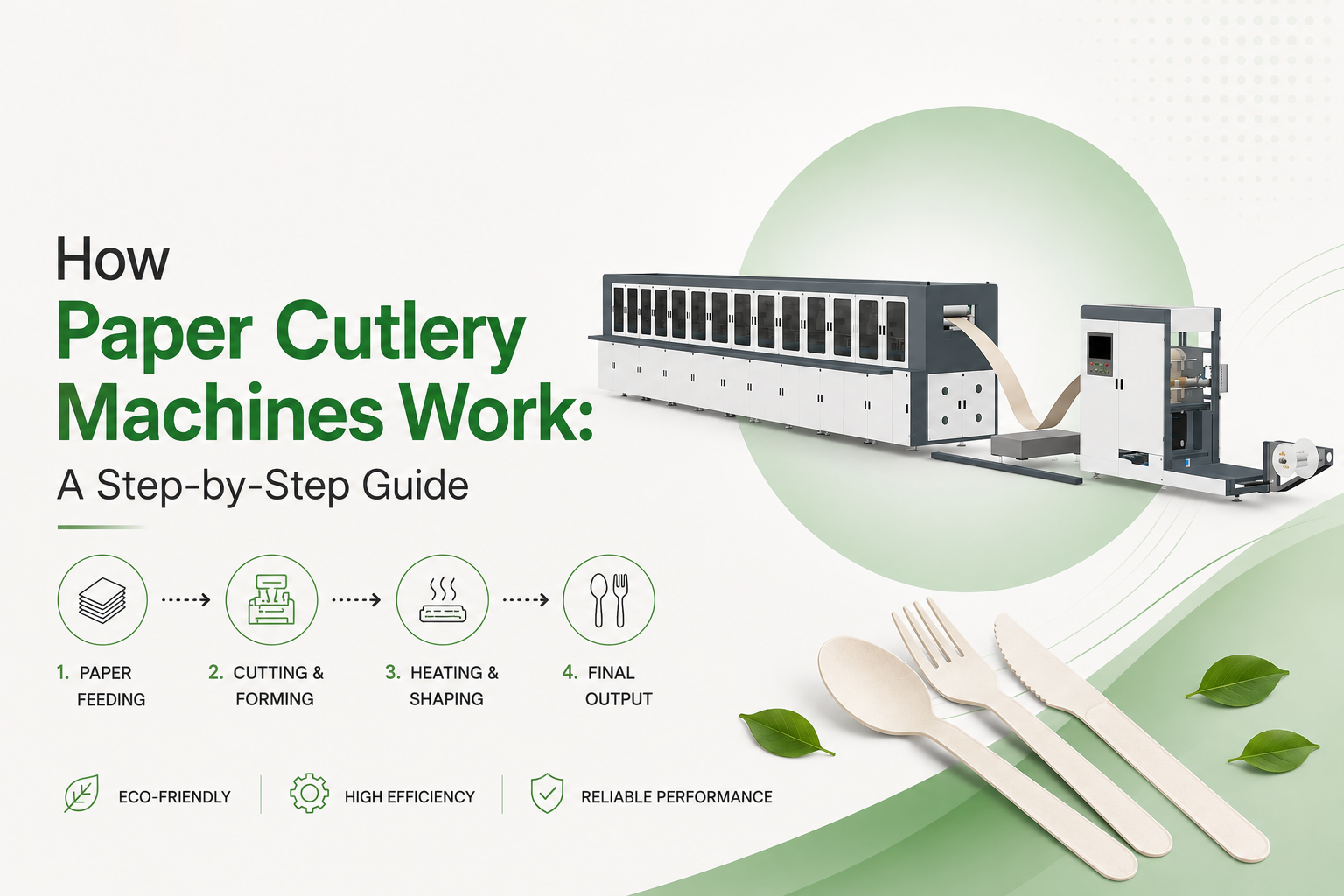
The demand for sustainable disposable tableware is growing rapidly as restaurants, catering companies, foodservice businesses, retailers, and other commercial users look for alternatives to conventional plastic utensils.
This growing demand has created new opportunities for manufacturers of disposable paper cutlery, including paper spoons, forks, knives, ice cream spoons, and soup spoons. To meet production requirements, businesses are increasingly investing in automated equipment that can manufacture paper-based utensils efficiently and consistently.
A paper cutlery machine is designed to transform suitable paper-based raw materials into finished disposable cutlery through a series of controlled manufacturing processes. Depending on the machine configuration, the production line can include material feeding, adhesive application, preheating, die cutting, molding, embossing, coating, heating, quality inspection, counting, stacking, and packaging.
But how exactly does a paper cutlery making machine work?
This guide explains the complete paper cutlery manufacturing process, different types of machines, applications, benefits, and important factors to consider when selecting a paper cutlery machine manufacturer.
What Is a Paper Cutlery Machine?
A paper cutlery machine is industrial equipment used to manufacture disposable utensils from suitable paperboard or paper-based materials.
Depending on the machine configuration and mold design, the equipment can produce:
- Paper spoons
- Paper forks
- Paper knives
- Ice cream spoons
- Soup spoons
- Other customized paper utensils
The basic production process combines controlled feeding, heating, cutting, forming, molding, coating, inspection, and packaging to convert flat paper material into finished cutlery.
Modern automatic paper cutlery machines can integrate several production stages into one manufacturing line. This reduces manual handling and allows manufacturers to maintain more consistent production across larger volumes.
The exact process can vary according to the machine model, raw material, product design, mold configuration, and coating requirements.
Why Is Paper Cutlery Becoming More Popular?
The growing market for eco-friendly cutlery is being driven by changing consumer preferences, foodservice requirements, and the wider movement toward alternative disposable materials.
Growing Demand for Sustainable Tableware
Restaurants, cafés, caterers, takeaway businesses, and retailers are increasingly exploring alternatives to conventional plastic disposable tableware.
Changing Plastic Consumption
Restrictions and changing attitudes toward single-use plastics have encouraged manufacturers and foodservice businesses to consider paper-based alternatives.
Commercial Production Opportunities
The increasing demand for disposable paper cutlery has created opportunities for businesses interested in manufacturing spoons, forks, knives, and other disposable tableware products.
Product Customization
A properly configured paper cutlery manufacturing machine can support different product shapes, dimensions, and designs through appropriate tooling and molds.
Greater Production Control
Manufacturing cutlery in-house can provide businesses with greater control over production schedules, product specifications, quality, and order volumes.
How Does a Paper Cutlery Machine Work?
The paper cutlery manufacturing process involves multiple stages. Each stage contributes to the shape, strength, appearance, and usability of the final product.
While the exact configuration may differ between machines, the general process includes the following steps.
Step 1: Raw Material Feeding
The production of paper cutlery begins with feeding suitable food-grade paper or paperboard into the machine.
The feeding system transfers the raw material at a controlled speed and maintains consistent movement throughout the production line.
Proper material feeding is essential because inconsistent feeding can affect alignment, cutting accuracy, molding, and the overall quality of the finished product.
The material specification can vary according to the product being manufactured. Factors such as paper thickness, strength, composition, and coating requirements should be considered before production.
For manufacturers producing high volumes of disposable paper cutlery, an automated feeding system can reduce repetitive manual handling and provide a more consistent material flow.
Step 2: Adhesive Application and Preheating
Depending on the machine configuration and product requirements, multiple layers of paper may be bonded together using an automated adhesive mechanism.
The adhesive system applies the required material before controlled heat and pressure are introduced.
Preheating prepares the paper material for subsequent cutting and forming operations. Temperature and pressure need to be controlled carefully because variations can influence bonding, flexibility, and final product quality.
A well-designed paper cutlery making machine therefore needs reliable heating and pressure-control systems to maintain consistent manufacturing conditions.
Step 3: Die Cutting
Once the raw material has been prepared, it moves into the die-cutting section.
The die-cutting system cuts the paper according to the required product shape and mold specification.
For example, different tooling can be used for a spoon, fork, or knife design.
Advanced automatic paper cutlery machines can incorporate servo-driven mechanisms and automated controls to improve positioning accuracy and repeatability.
During this stage, the basic profile of the paper utensil is created before the product moves to the forming and molding section.
Step 4: Forming and Molding
After die cutting, the prepared pieces are transferred to the forming section.
This is one of the most important stages of the paper cutlery manufacturing process because it converts the flat cut material into the required three-dimensional shape.
The forming system uses controlled pressure and heat to shape the product according to the selected mold.
For paper spoons, the mold creates the bowl-shaped section. For forks and knives, the tooling determines the required profile and dimensions.
The accuracy of the paper cutlery molding machine directly influences the consistency and appearance of the finished products.
Step 5: Embossing
Following the initial forming process, embossing can be performed depending on the product design.
Embossing adds specific patterns, structures, or design details to the surface of the cutlery.
The forming and embossing system must maintain accurate pressure and positioning to ensure that each piece has a consistent appearance.
For manufacturers producing customized paper cutlery, embossing can also contribute to product differentiation.
Step 6: Food-Grade Coating
After forming and embossing, the products may undergo a coating process depending on their intended application and material specification.
A suitable food-grade coating can help improve resistance to moisture, oils, and other conditions encountered during foodservice use.
During this stage, the products pass through the coating section, where the selected coating material is applied according to the production requirements.
The coating used should be appropriate for the intended food-contact application.
For manufacturers producing biodegradable cutlery, it is particularly important to understand the complete material composition rather than assuming that every paper-based product is automatically biodegradable or compostable.
Step 7: Heating and Drying
After coating, the products pass through a controlled heating section.
The heating stage helps dry or set the coating and prepares the finished disposable paper cutlery for subsequent inspection.
Controlled heating is important for maintaining consistent surface characteristics and preventing unwanted variations between products.
An efficiently designed paper cutlery manufacturing machine should provide appropriate temperature control throughout the heating process.
Step 8: Quality Inspection
Quality inspection is an essential part of commercial paper cutlery production.
Depending on the machine configuration, automated sensors or manual inspection points can be used to identify defective products.
Common quality issues may include:
- Incorrect shape
- Uneven molding
- Cracks
- Surface defects
- Incomplete forming
- Coating inconsistencies
- Contamination
Defective pieces can be removed before the products reach the packaging stage.
Consistent inspection becomes increasingly important as production volumes increase because even a small defect rate can result in a significant number of rejected products during large-scale disposable tableware production.
Step 9: Counting and Stacking
Once the products pass quality inspection, they move to the counting and stacking section.
The automated system counts finished spoons, forks, knives, or other products and arranges them into predetermined quantities.
Automated counting reduces manual labour and helps maintain consistent quantities across production batches.
For businesses producing large quantities of disposable paper cutlery, automated stacking can also simplify the transition from manufacturing to packaging.
Step 10: Packaging
The final stage of the paper cutlery manufacturing process is packaging.
Depending on customer requirements, finished products can be packed into:
- Bags
- Boxes
- Bundles
- Individual packs
- Disposable cutlery sets
Some production configurations can integrate packaging equipment with the main manufacturing line, while other businesses may perform packaging as a separate downstream operation.
Once packaged, the finished paper cutlery can be prepared for storage, distribution, retail, catering, restaurant supply, or other commercial applications.
Types of Paper Cutlery Machines
Different manufacturers have different production requirements. Therefore, the right paper cutlery making machine depends on factors such as production volume, product range, automation requirements, available space, and budget.
1. Semi-Automatic Paper Cutlery Machine
Semi-automatic systems require some operator involvement during production.
They can be suitable for smaller businesses or manufacturers that are entering the disposable tableware market and want to begin production at a manageable scale.
2. Automatic Paper Cutlery Machine
A fully automatic paper cutlery machine can integrate several manufacturing stages with limited manual intervention.
Depending on the configuration, automation can cover feeding, cutting, forming, molding, inspection, counting, and stacking.
These systems are generally suitable for businesses targeting higher-volume paper cutlery production.
3. Multi-Cavity Paper Cutlery Machine
Multi-cavity machines are designed to produce multiple products during a single forming cycle.
This configuration can increase production output and improve manufacturing efficiency when demand for disposable paper cutlery is high.
4. Customized Paper Cutlery Manufacturing Machine
Some manufacturers require specialized machines based on their product range, dimensions, molds, or production requirements.
A customized paper cutlery manufacturing machine can be configured around specific production objectives rather than relying on a standard setup.
What Products Can a Paper Cutlery Making Machine Produce?
Depending on machine design and tooling, a paper cutlery making machine can be configured to manufacture different disposable utensils.
Common products include:
Paper Spoons
Paper spoons can be used for takeaway meals, desserts, ice cream, catering, and other foodservice applications.
Paper Forks
Paper forks are suitable for restaurants, takeaway businesses, catering services, events, and disposable food packaging.
Paper Knives
Paper knives can be used where disposable knives are required for foodservice and takeaway applications.
Ice Cream Spoons
Specialized tooling can be used for producing smaller spoons suitable for ice cream, desserts, and similar applications.
Soup Spoons
Deeper spoon designs can be produced for applications where the utensil needs to accommodate liquid or semi-liquid foods.
The final product range depends on the machine configuration and available molds.
Applications of Disposable Paper Cutlery
The demand for eco-friendly cutlery extends across several industries.
Restaurants and Cafés
Restaurants and cafés can use disposable spoons, forks, and knives for takeaway and selected foodservice applications.
Catering and Events
Catering companies and event organizers often require large quantities of disposable tableware for serving guests.
Takeaway and Food Delivery
Disposable paper cutlery can be supplied with takeaway meals and food-delivery orders where convenient single-use utensils are required.
Hotels and Hospitality
Hotels, resorts, and hospitality businesses can use disposable tableware for selected events, room-service requirements, outdoor activities, and catering operations.
Institutional Foodservice
Schools, offices, hospitals, canteens, and other institutions may use disposable cutlery for specific foodservice applications.
Retail
Manufacturers can also package disposable tableware for retail and household customers.
Benefits of Using an Automatic Paper Cutlery Machine
Investing in an automatic paper cutlery machine can provide several production advantages.
Consistent Product Quality
Automated feeding, cutting, forming, and stacking can help maintain greater consistency throughout production.
Reduced Manual Labour
Automation reduces repetitive manual operations and allows operators to focus on monitoring and managing the production process.
Higher Production Efficiency
Integrated production stages can streamline the movement of raw materials and finished products.
Improved Process Control
Automated systems allow manufacturers to control important production parameters such as temperature, pressure, material movement, and forming.
Scalable Production
Manufacturers can select machine configurations according to their required output and gradually expand production as demand increases.
Better Counting and Stacking
Automated counting and stacking reduce manual handling and make packaging preparation easier.
Paper Cutlery Machine vs Manual Production
| Factor | Automatic Paper Cutlery Machine | Manual Production |
|---|---|---|
| Production speed | High | Low |
| Product consistency | High | Operator dependent |
| Manual labour | Lower | Higher |
| Counting | Automated | Manual |
| Stacking | Automated | Manual |
| Production scalability | High | Limited |
| Process control | Automated | Manual |
| High-volume production | Suitable | Difficult |
For businesses targeting commercial-scale paper cutlery production, automation can significantly improve process efficiency and reduce repetitive manual operations.
How to Choose a Paper Cutlery Machine Manufacturer?
Choosing the right paper cutlery machine manufacturer is an important decision for any business planning to enter or expand its disposable tableware production.
The machine should not be evaluated on purchase price alone. Manufacturers should consider the complete production requirement.
Machine Construction
Look for robust construction and components designed for continuous industrial operation.
Production Capacity
Evaluate the expected production requirement and compare it with the machine’s actual operating capacity.
Instead of selecting a machine only on its maximum advertised output, consider the expected production schedule, product type, mold configuration, and operating conditions.
Automation Level
Determine whether a semi-automatic or automatic paper cutlery machine is more appropriate for your production requirements.
Mold Configuration
If you plan to manufacture different products, check whether the machine supports the required molds and tooling.
This is especially important when manufacturing paper spoons, forks, knives, ice cream spoons, or customized products.
Material Compatibility
Confirm that the machine is compatible with the paperboard, paper thickness, adhesive, and coating materials required for your products.
Heating and Forming Control
Consistent temperature and forming pressure are important for achieving reliable product quality.
After-Sales Support
Installation assistance, operator training, maintenance support, troubleshooting, and spare-parts availability can influence the long-term performance of a paper cutlery manufacturing machine.
Food-Safety Requirements
Because paper cutlery is intended for foodservice applications, manufacturers should ensure that the materials, coatings, and production process meet the applicable requirements for their target market.
Manufacturer Experience
When evaluating paper cutlery machine manufacturers, consider their experience, machine specifications, technical support, previous installations, and ability to provide suitable production solutions.
Environmental Considerations of Paper Cutlery
One of the main reasons for the growing interest in biodegradable cutlery and paper-based disposable tableware is the search for alternatives to conventional single-use plastic products.
However, the environmental performance of paper cutlery depends on several factors.
These include:
- Type of paper used
- Raw material sourcing
- Coating composition
- Manufacturing process
- Product usage
- Disposal method
- Recycling infrastructure
- Composting conditions
Therefore, manufacturers should avoid assuming that every paper product is automatically biodegradable or compostable.
If a product is marketed as biodegradable cutlery, compostable cutlery, or eco-friendly tableware, the relevant material composition and certifications should be verified.
This approach allows businesses to make more accurate sustainability claims while selecting appropriate materials for their products.
Future of Paper Cutlery Manufacturing
The future of paper cutlery production is likely to focus increasingly on automation, process control, production efficiency, and material development.
Modern machinery is moving toward systems that can provide greater control over important manufacturing parameters.
Key areas of development include:
- Automated material handling
- Improved forming accuracy
- Advanced heating systems
- Automated counting
- Automated stacking
- Production monitoring
- Reduced manual intervention
- Improved energy efficiency
As demand for eco-friendly cutlery and alternative disposable tableware develops, manufacturers will increasingly need production systems capable of delivering consistent quality at commercial volumes.
For businesses operating in this market, choosing a reliable paper cutlery manufacturing machine can therefore play an important role in establishing an efficient and scalable production operation.
Frequently Asked Questions About Paper Cutlery Machines
What is a paper cutlery machine?
A paper cutlery machine is industrial equipment used to manufacture disposable paper-based utensils such as spoons, forks, knives, ice cream spoons, and soup spoons.
How does a paper cutlery machine work?
A typical paper cutlery manufacturing process includes raw material feeding, adhesive application, preheating, die cutting, forming, molding, embossing, coating, heating, quality inspection, counting, stacking, and packaging.
What raw material is used for paper cutlery?
Suitable food-grade paper or paperboard can be used depending on the product design, thickness, strength, coating, and intended application.
What products can a paper cutlery making machine produce?
Depending on the mold and machine configuration, manufacturers can produce paper spoons, paper forks, paper knives, ice cream spoons, soup spoons, and other customized disposable utensils.
Is an automatic paper cutlery machine suitable for large-scale production?
Yes, an automatic paper cutlery machine can be suitable for commercial production where manufacturers require higher output, reduced manual handling, and consistent production.
Can one paper cutlery manufacturing machine produce different products?
This depends on the machine design and tooling. Some machines can accommodate different molds and product configurations, while others are designed for specific products.
What should I consider when choosing a paper cutlery machine manufacturer?
Important factors include production capacity, automation level, machine construction, mold configuration, material compatibility, heating and forming control, technical support, spare-parts availability, and applicable food-safety requirements.
Is paper cutlery biodegradable?
Not every paper-based product is automatically biodegradable. The answer depends on the paper material, coating, product composition, and disposal conditions. Manufacturers should verify relevant product specifications and certifications before making environmental claims.
How can a paper cutlery machine improve production?
A paper cutlery making machine can automate repetitive manufacturing processes such as feeding, cutting, forming, counting, and stacking, helping manufacturers improve consistency and reduce manual handling.
Conclusion
The growing demand for alternatives to conventional plastic tableware has created new opportunities in paper cutlery manufacturing.
A modern paper cutlery machine combines several production stages to transform suitable paper-based materials into finished spoons, forks, knives, and other disposable utensils. From raw material feeding and preheating to die cutting, molding, embossing, coating, heating, quality inspection, counting, stacking, and packaging, each stage contributes to the final product.
For businesses planning to enter or expand in the disposable tableware industry, selecting the right paper cutlery manufacturing machine is an important investment decision.
Production capacity, automation, tooling, material compatibility, quality control, machine construction, technical support, and after-sales service should all be evaluated before selecting a supplier.
Working with an experienced paper cutlery machine manufacturer can help businesses establish a reliable production process and manufacture consistent disposable paper cutlery for restaurants, catering companies, takeaway businesses, retailers, hospitality providers, and other foodservice applications.
As the market for sustainable and alternative disposable tableware continues to develop, efficient paper cutlery production can provide manufacturers with an opportunity to meet changing customer requirements while building a scalable manufacturing operation.