Admin
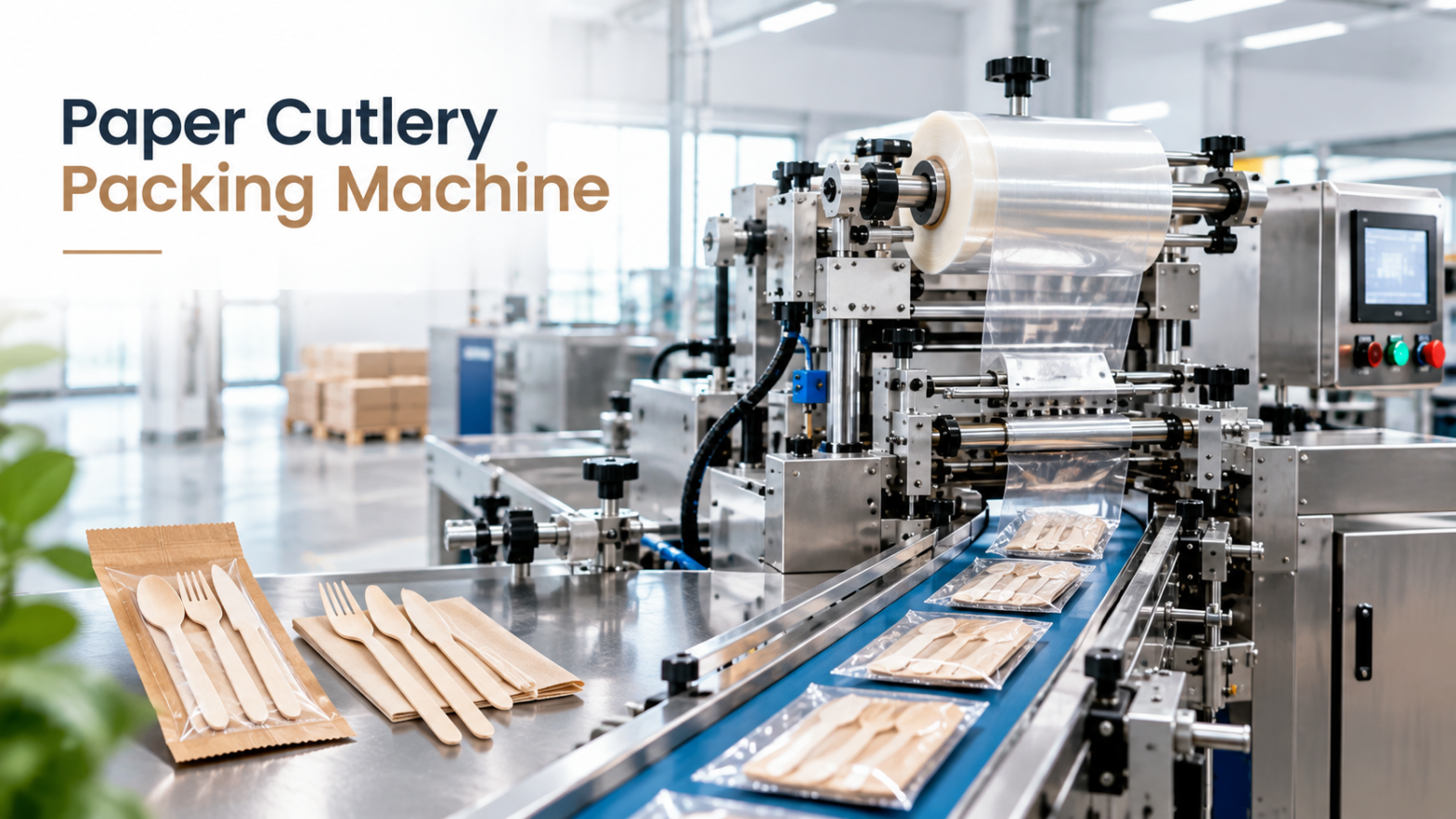
Buying a paper cutlery machine is a capital decision with many variables. The line must laminate, cut, form, coat and dry thin paper into spoons, forks and knives that hold their shape in hot food, and it must do so at a rate that justifies the investment. This guide explains what a paper cutlery machine does, how production works, which specifications and costs to evaluate, and how to assess a manufacturer. It uses published figures for Prosper Universal’s paper cutlery machine line where available and separates them from general buying advice.
What Is a Paper Cutlery Machine?
A paper cutlery machine is an automated production line that turns reels of food-grade paper into disposable spoons, forks and knives. In practice it is a set of machines rather than one unit. Prosper Universal’s line has a laminating and die-cutting machine and a forming and sealing machine, plus a separate packing machine for finished products. It differs from pulp moulding equipment, which forms products from wet fibre slurry. A paper cutlery making machine starts with paper reels, which are bonded in layers, cut into blanks, then embossed, coated and dried.
The Paper Cutlery Manufacturing Process
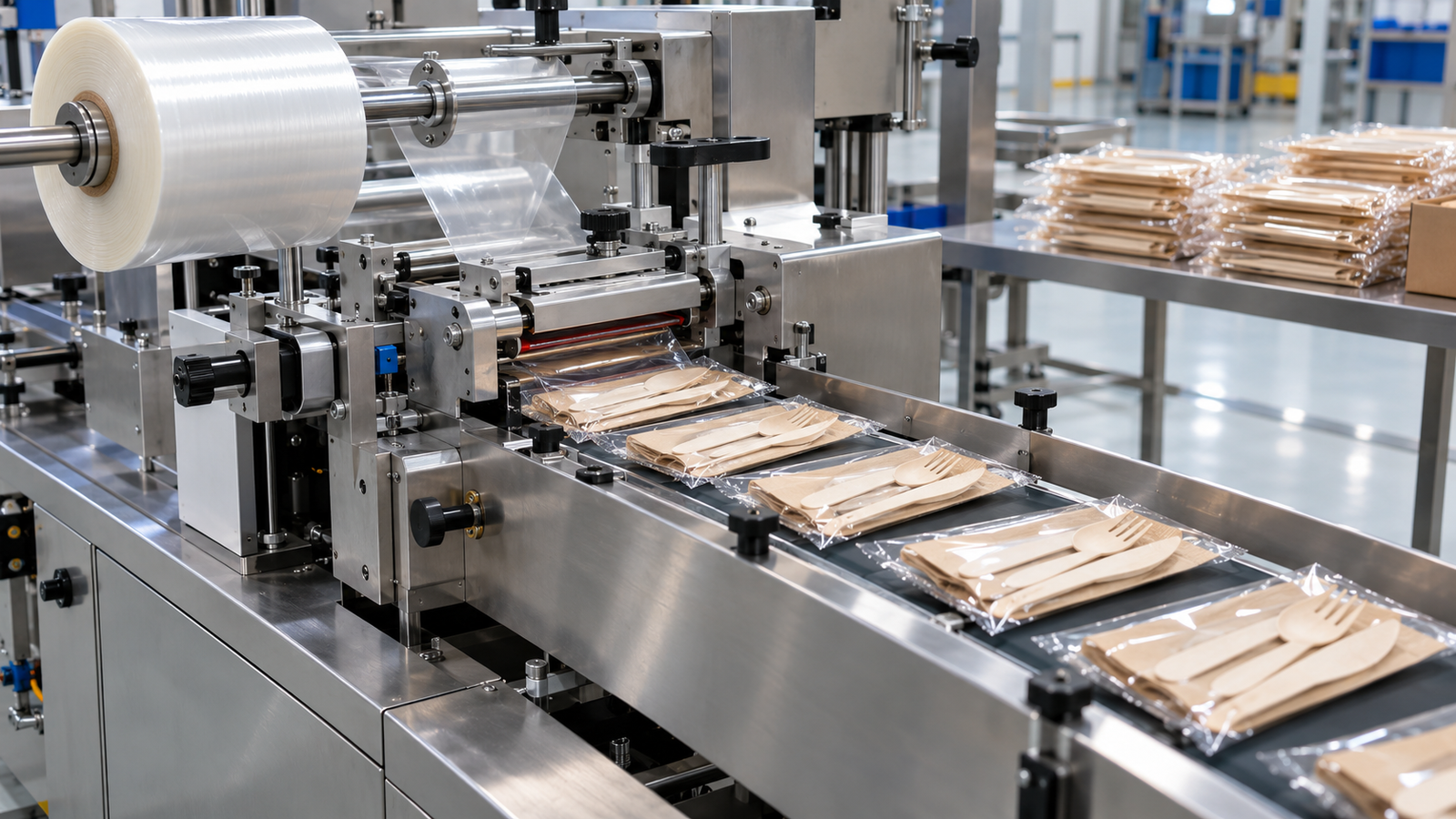
The paper cutlery manufacturing process follows a fixed sequence, and each stage affects the next. The table summarises the stages as Prosper Universal describes them, with the main buyer concern at each one.
| Stage | What happens | What buyers should check |
| Laminating | Paper is glue-coated and hot-pressed into a board of 6 to 9 layers | Glue quality, layer count, roller cleaning |
| Die cutting | A replaceable, servo-driven mould cuts blanks | Mould accuracy, edge quality, waste |
| Forming and sealing | A nozzle moves blanks from a storage mould to a hydraulic press mould for embossing | Forming pressure, number of stations |
| Coating | Products are immersed in an oil- and water-resistance coating, and a vacuum removes the surplus | Coating type, consumption, food-contact suitability |
| Drying | A dry-air heating section with ceramic heaters finishes the product | Heating length, stacking, product release |
| Packing | A separate machine bags and seals finished items | Bag size range, speed, film |
Paper Cutlery Machine Production Capacity and Specifications
Prosper Universal publishes the following figures for its PR400 line. Treat them as manufacturer data to confirm in writing for your product.
| Specification | Published figure |
| Applicable products | All types of paper cutlery, as per machine capability |
| Raw material | Food-grade paper and food-grade glue |
| Paper thickness, standard mould | 800–1000 gsm |
| Maximum paper layers | 9 |
| Mould size | 400 × 500 mm |
| Forming pressure | 50 T |
| Cutting speed | 200–400 pcs/min, depending on cutlery size |
| Forming speed | 80–100 pcs/min |
| Total power | 150 kW |
| Air supply | 1.0 m³/min |
| Power supply | 3-phase, 4-wire, 420 V, 50 Hz |
| Installation area | 150 m² |
| Gross weight | 15 MT |
Cutting speed and finished output are different things. Cutting produces blanks, while forming shapes the finished piece, so the slower forming figure of 80–100 pcs/min is the better guide to output. As a simple illustration, 80–100 pieces per minute equals 4,800–6,000 pieces per hour of continuous running. Real output is lower once mould changes, glue and coating top-ups, maintenance and downtime are included, and it varies with cutlery size, mould design and paper properties.
Ask how many forming units the cutting machine feeds in the quoted configuration. Also ask for a trial run on your paper and mould. The product page labels both main units “PR400 – Part 1”, so confirm exact model names on the quotation.
Paper Cutlery Machine Price and Total Investment
Prosper Universal does not publish prices on its product page, so request a written quotation. Compare quotations on scope, not just the headline figure:
- Configuration: the number of forming units, mould sets and design variants included.
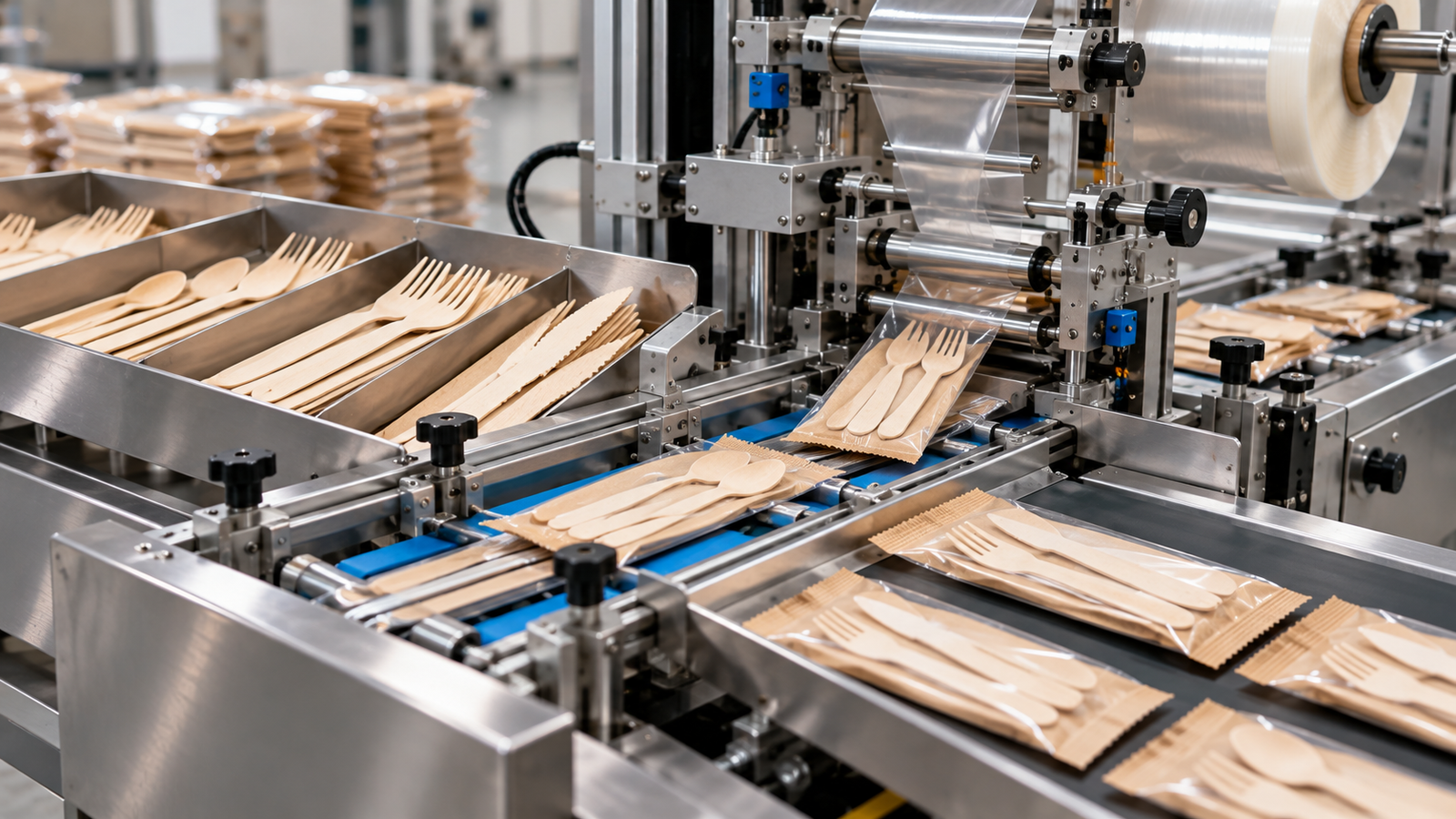
- Packing: finished cutlery usually needs a packing machine. Prosper Universal’s automatic cutlery packing machine lists 40–200 bags per minute, 6.8 kW power and a 950 kg weight.
- Utilities and site: power connection, compressed air, foundation and a 150 m² layout.
- Consumables: paper, glue and coating chemical.
- Logistics: freight, duties and installation for export orders.
- People and spares: operator training and a spare-parts kit.
No payback period or margin can be stated without your own costs, selling prices and utilisation, so build that model from quoted figures.
Regulation and Product Claims
Demand for paper cutlery is linked to restrictions on plastic. A Ministry of Environment, Forest and Climate Change reply in Parliament records that the Plastic Waste Management Amendment Rules, 2021 prohibited the manufacture, sale and use of identified single-use plastic items, including cutlery such as forks, spoons and knives, from 1 July 2022. This supports the market for alternatives, but it does not certify any product. Before you describe cutlery as compostable, biodegradable, microwave-safe or food-safe, obtain test reports for your paper, glue and coating combination.
How to Choose a Paper Cutlery Machine Manufacturer
A good paper cutlery machine manufacturer will answer the following questions with documents rather than slogans:
- Output: what finished pieces per hour does the line achieve for your product size?
- Trial: can you run your own paper and mould before ordering?
- Utilities: are power, air, space and floor-load requirements stated in writing?
- Moulds: who designs and machines them? Prosper Universal’s mould development service describes a workflow from customer sample or 3D drawing through tooling design, VMC machining, prototype trial and client sample testing.
- Materials: which paper grades, glue and coating does the supplier recommend?
- Safety and controls: does the line use PLC control, sensors, guards and emergency stops?
- Support: who installs, trains operators and supplies spares?
Installation, Commissioning and Maintenance
Plan the site before the machine arrives. A 15 MT gross weight and a 150 m² footprint call for suitable foundations, handling equipment and layout, and the 150 kW load needs a matching three-phase supply. Prosper Universal’s after-sales services page lists on-site installation and commissioning and after-sales support among its project steps. The cutting machine includes a cleaning system for the glue roller and glue tray, and the cutting mould is replaceable, so schedule routine cleaning, mould inspection and heater checks. Keep a record of settings for each product so changeovers stay repeatable.
Frequently Asked Questions
What is the difference between cutting speed and forming speed?
Cutting speed is the rate at which blanks are cut, published as 200–400 pcs/min depending on size. Forming speed, published as 80–100 pcs/min, is the rate at which finished pieces are shaped. Finished output depends mainly on the slower stage.
Which paper does a paper cutlery making machine use?
Prosper Universal lists food-grade paper and food-grade glue, with paper similar to straw paper but without polyethylene coating. Standard moulds use 800–1000 gsm paper. Confirm your paper supplier and grade with the manufacturer before ordering.
Can one line make spoons, forks and knives?
The product page says all types of paper cutlery, as per machine capability. Each shape needs its own mould within the 400 × 500 mm mould size, so confirm that your designs are feasible.
What should I prepare before installation?
Prepare floor space, foundations, a three-phase power connection, compressed air and trained operators. Ask the supplier for a layout drawing and utility list so civil work can be completed in advance.
How is finished cutlery packed?
A separate machine handles packing. The published PR8500 packing machine handles 40–200 bags per minute, with bag lengths of 90–330 mm and film thickness of 0.018–0.06 mm. Check that bag size and speed match your cutlery and forming output.
Is paper cutlery automatically compostable?
No. Compostability depends on the paper, glue and coating, and must be shown by testing against the standard your market recognises. The machine alone does not guarantee it.
Conclusion
A paper cutlery machine should be judged on the full production chain: laminating, die cutting, forming, coating, drying and packing. Buyers should compare finished output rather than cutting speed, confirm utilities and floor space, understand what the quotation includes and verify the manufacturer’s mould, trial and support capability. Claims about compostability or food safety need separate evidence.
If you are planning paper cutlery production, share your product sizes, target output and site details, and contact Prosper Universal to discuss suitable machinery or request a quotation. The team can help you match machine configuration, moulds and packing to your requirements.