Admin
Admin 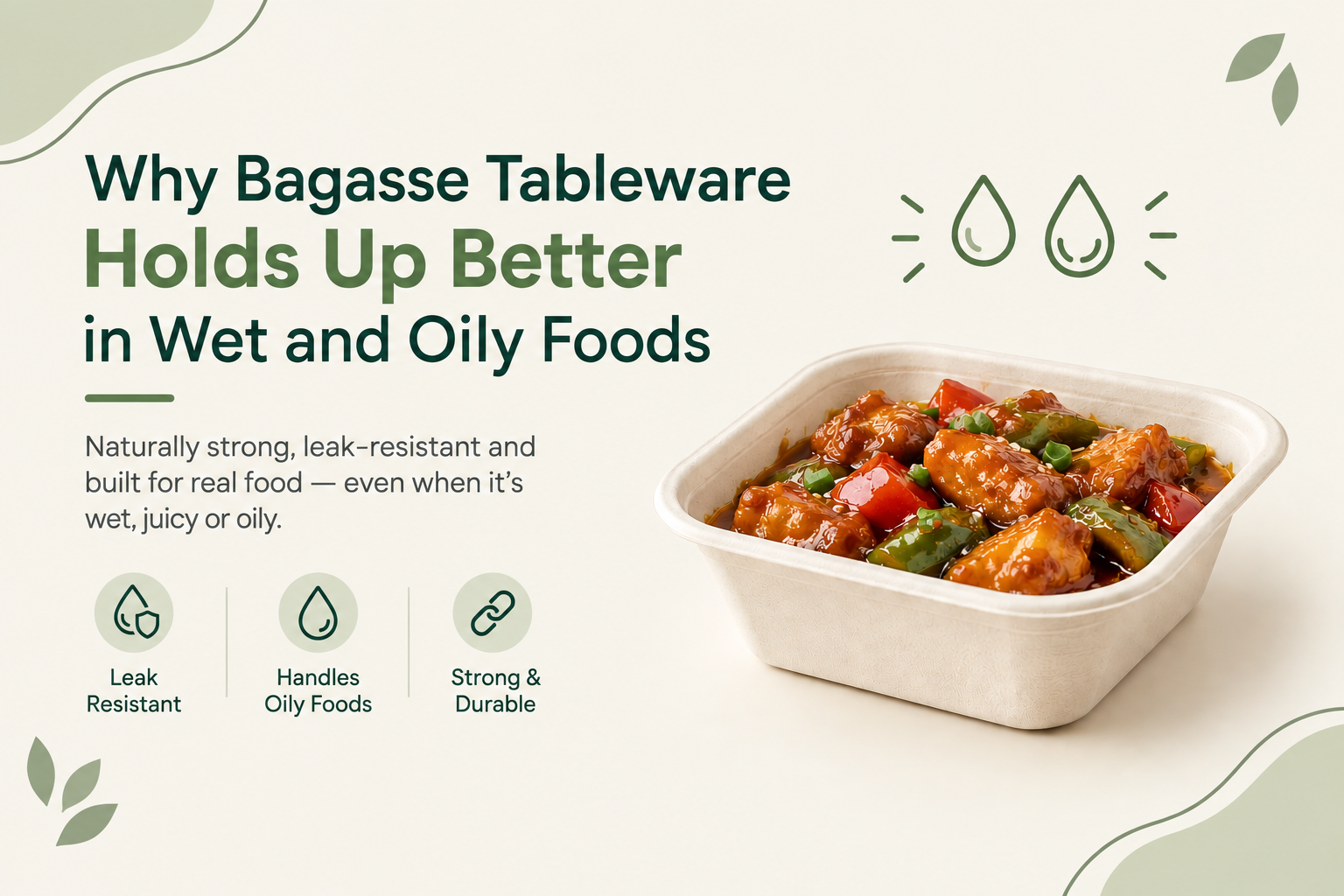
If you have ever watched a paper plate go soft and buckle under a slice of pizza or a scoop of curry, you already understand why foodservice buyers are switching to bagasse tableware for hot and greasy food. Bagasse – the fibrous pulp left over after sugarcane is crushed for juice – has quickly become the go-to material for restaurants, caterers, and packaging distributors who need plates and containers that survive real kitchen conditions, not just a lab test. In this guide, we break down exactly why bagasse tableware for hot and greasy food outperforms paper alternatives, what “FDA-approved, food-grade, oil- and water-resistant, chemically biodegradable containers” actually means on a spec sheet, and how to evaluate leak-proof compostable plates for your own menu.
What Makes Bagasse Different From Paper
Paper plates are made from wood pulp fibers that are naturally hydrophilic – they absorb water and oil almost immediately. That is why a plain paper plate wilts under a burger or turns translucent under fried chicken. Bagasse tableware for hot and greasy food is molded under high heat and pressure, which compresses the sugarcane fibers into a dense, rigid structure. This molding process closes up much of the fiber’s natural porosity, giving the finished plate a tighter surface that resists penetration from moisture and fats far better than standard paper stock.
Manufacturers also apply a thin, food-safe coating to many bagasse products to further improve performance. This is where the idea of “FDA-approved, food-grade, oil- and water-resistant, chemically biodegradable containers” comes in – the coating (often a PFAS-free bio-based barrier) blocks grease and liquid without compromising the container’s ability to break down after disposal. The result is a plate or clamshell that behaves like plastic in the kitchen but like compost in the ground.
The Science of Oil and Water Resistance in Bagasse
Grease resistance in foodservice packaging is typically measured using the Kit test (TAPPI T559), which rates a material’s resistance to oil penetration on a scale of 0 to 12. Standard uncoated paper plates often score below a 3, while properly manufactured bagasse tableware for hot and greasy food can score 8 or higher when treated with an appropriate barrier layer. Water resistance is measured separately using Cobb testing, which tracks how much water a material absorbs over a set time period. Bagasse’s denser fiber matrix, combined with its molded thickness (often 1.5–2mm compared to a paper plate’s fraction of a millimeter), gives it a structural head start before any coating is even applied.
This is why bagasse tableware for hot and greasy food is now standard in cuisines and dishes that punish ordinary disposables: butter chicken, biryani, fried appetizers, pasta in oil-based sauces, and barbecue platters with dripping sauces. The plate holds its shape from the moment food is plated to the moment it’s thrown away — no sagging, no soak-through, no embarrassing leaks onto a customer’s lap.
Bagasse vs Paper Plates Performance: A Side-by-Side Comparison
The table below summarizes bagasse vs paper plates performance across the metrics that matter most to foodservice operators.
| Performance Factor | Bagasse Tableware | Standard Paper Plates |
| Oil resistance (Kit rating) | 8–12 with barrier coating | 1–3 uncoated |
| Water resistance | High – holds liquid for hours | Low – soaks through in minutes |
| Heat tolerance | Stable up to ~200°F / 93°C | Warps and softens with heat |
| Rigidity under load | Holds shape with heavy, wet food | Sags and bends easily |
| Microwave-safe | Yes, in most cases | Rarely |
| Compostability | Breaks down in 60–90 days commercially | Depends on coating; many are not compostable |
| Best for | Curries, fried food, sauces, hot entrées | Dry snacks, desserts, light foods |
This comparison makes it clear why bagasse vs paper plates performance is no longer a close contest for wet or oily menu items. Paper still has a place for dry finger foods, but anywhere grease or liquid is involved, bagasse tableware for hot and greasy food is the more reliable choice.
FDA-Approved, Food-Grade Standards Explained
When you see a product listed as FDA-approved, food-grade, oil- and water-resistant, chemically biodegradable containers, it means the material has been evaluated for direct food contact safety under U.S. Food and Drug Administration guidelines, and that any coatings used do not migrate harmful substances into food. For buyers sourcing bagasse tableware for hot and greasy food, this certification is non-negotiable — it confirms the container can safely hold hot, acidic, or fatty foods without leaching chemicals.
Reputable suppliers should be able to provide documentation proving their line of FDA-approved, food-grade, oil- and water-resistant, chemically biodegradable containers meets these requirements, along with third-party lab results for grease and water resistance. If a supplier can’t produce this paperwork, treat that as a red flag, especially if you’re serving hot and greasy dishes at scale.
Why Leak-Proof Compostable Plates Matter for Foodservice
Leak-proof compostable plates solve two problems at once: they protect the customer experience (no soggy bottoms, no grease seeping through packaging bags), and they satisfy the growing number of municipalities and corporate sustainability policies that require compostable or biodegradable serviceware. A plate can be technically compostable and still fail in practice if it leaks before it ever reaches a compost bin – which is why leak-proof compostable plates, not just “compostable” plates in general, should be the benchmark operators use when comparing suppliers.
Restaurants running delivery and takeout in particular need leak-proof compostable plates and containers, since food often sits in a bag for 20–40 minutes before it’s opened. Bagasse tableware for hot and greasy food is particularly well suited to this use case because it maintains its integrity well past the point paper packaging would have failed.
Best Use Cases: Hot, Greasy, and Wet Foods
- Fried foods: Fritters, pakoras, fried chicken, and tempura benefit from bagasse’s oil resistance, keeping the plate crisp-looking rather than translucent.
- Curries and gravies: Bagasse tableware for hot and greasy food holds up under thin, watery gravies that would soak through paper in under a minute.
- Barbecue and grilled meats: Dripping sauces and fats are contained rather than pooling through the base of the plate.
- Pasta and oil-based dishes: Olive oil and butter-heavy sauces are common failure points for standard paper, but not for properly coated bagasse.
- Hot soups and stews (in bagasse bowls/containers): Heat tolerance combined with water resistance keeps the container rigid for the full meal.
How to Choose the Right Bagasse Tableware for Your Business
- Confirm certification: ask specifically for FDA-approved, food-grade, oil- and water-resistant, chemically biodegradable containers with documentation, not just a verbal claim.
- Ask for Kit and Cobb test results if you serve consistently greasy or wet menu items.
- Order samples and test with your actual menu – a curry test is more useful than a marketing claim.
- Confirm compostability certification (such as BPI or EN 13432) if you plan to market the packaging as leak-proof compostable plates.
- Compare thickness and rigidity, not just price – thin bagasse products can underperform despite the material.
If you’re evaluating suppliers at scale, it’s also worth reading our guide on private labeling bagasse tableware to understand how minimum order quantities and custom branding affect sourcing decisions, or our breakdown of bulk bagasse tableware for airlines, stadiums, and large event caterers if you’re sourcing at a much larger volume.
FAQs
Is bagasse tableware safe for hot and greasy food? Yes. Properly certified bagasse tableware for hot and greasy food is designed specifically to resist oil penetration and hold its structure under heat, making it safer and more reliable than standard paper plates for greasy or hot menu items.
What does “FDA-approved, food-grade, oil- and water-resistant, chemically biodegradable containers” mean? It means the container has passed food-contact safety review, uses a barrier that blocks oil and water without leaching chemicals, and is designed to biodegrade after disposal – all verified through recognized testing and certification.
Are leak-proof compostable plates actually leak-proof? When manufactured and coated correctly, yes – leak-proof compostable plates are tested for both oil and water resistance, not just marketed as compostable. Always ask for lab test results before assuming a plate qualifies.
How does bagasse vs paper plates performance compare for hot food specifically? Bagasse retains its rigidity and resists soak-through at temperatures that cause paper plates to soften and sag, which is why bagasse vs paper plates performance heavily favors bagasse for anything served hot.
Is bagasse tableware microwave-safe? Most bagasse tableware for hot and greasy food is microwave-safe, though it’s best to confirm with your specific supplier since coatings can vary.
A Quick Note on Cost vs Performance
Bagasse tableware typically costs more per unit than basic paper plates, which is often the first objection buyers raise. But when you factor in product failures, customer complaints, and reorders caused by leaks, the real-world bagasse vs paper plates performance gap tends to close that price difference quickly. Operators who switch to bagasse tableware for hot and greasy food often report fewer spill-related complaints and less packaging waste from failed orders, which offsets the higher unit cost over time.
The Bottom Line
For any operator serving hot, greasy, or liquid-heavy dishes, bagasse tableware for hot and greasy food isn’t a marketing upgrade – it’s a functional one. Between its oil and water resistance, its ability to hold shape under heat, and its compostability, bagasse consistently outperforms paper in the exact conditions where paper fails fastest. Whether you’re comparing bagasse vs paper plates performance for your own kitchen or sourcing leak-proof compostable plates for a delivery-heavy menu, look for verified FDA-approved, food-grade, oil- and water-resistant, chemically biodegradable containers before you commit to a supplier. If you’d like sourcing guidance for your specific menu or volumes, get in touch with the Prosper Universal team, or browse more sustainability insights on our blog.